
Buying Property in Torrevieja
Complete Guide for Foreign Buyers (2026)
Torrevieja is one of the most popular destinations in Spain for foreign property buyers, and for good reason: prices are significantly lower than in other Costa Blanca resorts, the climate is exceptional, and the city has a well-established international community that makes the transition to Spanish life considerably easier. This guide covers everything you need to know about buying property in Torrevieja — from finding the right area to understanding the costs, taxes, and legal process.
Why Buy Property in Torrevieja?
Before getting into the practicalities, it’s worth understanding what makes Torrevieja attractive to property buyers:
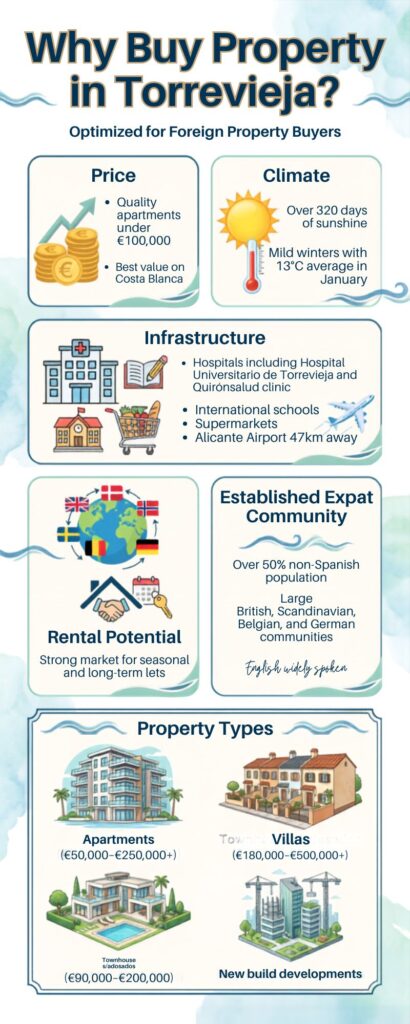
Price: Torrevieja offers some of the best value on the Costa Blanca. You can find quality apartments within walking distance of the beach for under €100,000 — a price point that simply doesn’t exist in Benidorm, Calpe, or Altea.
Climate: With over 320 days of sunshine per year and mild winters (average January temperature of 13°C), Torrevieja has one of the best climates in mainland Europe. It’s one of the reasons the area has consistently attracted retirees and long-term residents from northern Europe.
Infrastructure: The city has good hospitals (including the internationally renowned Hospital Universitario de Torrevieja and the private Quirónsalud clinic), international schools, a full range of supermarkets including British and German brands, and excellent transport links via Alicante Airport 47 kilometres away.
Established expat community: Torrevieja has one of the highest proportions of foreign residents of any Spanish city — over 50% of the population is non-Spanish, with large British, Scandinavian, Belgian, and German communities. This means English is widely spoken and the transition to life in Spain is considerably smoother than in less international areas.
Rental potential: The combination of tourism and long-term demand from expats makes Torrevieja a strong rental market, particularly for seasonal lets (spring and summer) and long-term lets targeting foreign residents.
Types of Property Available in Torrevieja
Apartments: The most common property type. Range from studio flats to large 3-bedroom apartments with sea views. Prices start from around €50,000 for older properties requiring renovation and go up to €250,000+ for modern apartments with pools and sea views.
Townhouses (adosados): Semi-detached or terraced houses, often in residential urbanisations outside the city centre. Typically offer more space and a private garden or terrace. Prices from €90,000 to €200,000.
Villas: Detached houses with private pools, usually in the urbanisations surrounding the city. Good villas start from around €180,000; luxury properties with sea views can exceed €500,000.
New build: There is significant new development around Torrevieja and the surrounding municipalities. Off-plan purchases can offer good value but require careful due diligence — more on this below.
Best Areas to Buy in Torrevieja
City centre and seafront
The historic centre and the streets immediately behind the seafront are ideal if you want to be within walking distance of restaurants, shops, the market, and the beach. Properties here are typically older apartment buildings. Expect to pay a premium for sea views.
Los Balcones
A popular residential urbanisation about 3 kilometres from the city centre, Los Balcones offers a mix of apartments, townhouses, and villas at good prices. Well established, with good amenities and a large expat community. Excellent value for money.
Los Altos
Located slightly further from the centre, Los Altos is known for larger villas and townhouses with private pools. Quieter and more spread out than Los Balcones. Popular with families and those wanting more space.
Punta Prima
A small coastal urbanisation about 5 kilometres south of Torrevieja, Punta Prima has a beautiful beach, a relaxed village atmosphere, and some of the most sought-after properties in the area. Prices are higher than average but the location justifies it.
El Chaparral
Further south, El Chaparral is a quieter residential area with a mix of apartments and villas. Less tourist-oriented than Punta Prima and popular with those who want a peaceful base with easy access to both Torrevieja and Orihuela Costa.
La Mata
The village of La Mata, 7 kilometres north of Torrevieja, sits between the natural park and a long sandy beach. It has a genuine village feel, fewer tourists than the city, and strong demand for both holiday and long-term rentals. Excellent value relative to its quality.
How Much Does Property Cost in Torrevieja?
As of 2026, average prices in Torrevieja and the immediate surrounding area are approximately:
| Property type | Price range |
|---|---|
| Studio / 1-bed apartment (needs work) | €40,000 – €70,000 |
| 2-bed apartment, city centre | €75,000 – €130,000 |
| 2-bed apartment with pool, urbanisation | €90,000 – €160,000 |
| 3-bed apartment with sea views | €150,000 – €250,000 |
| 2-bed townhouse with garden | €100,000 – €180,000 |
| 3-bed villa with pool | €180,000 – €350,000 |
| Luxury villa with sea views | €350,000 – €600,000+ |
Prices have risen steadily since 2020, driven by strong demand from northern European buyers and the increased appeal of remote work. However, Torrevieja remains significantly cheaper than comparable locations on the Costa del Sol.
The Buying Process Step by Step
Step 1: Get your NIE (Número de Identificación de Extranjero)
A NIE is a Spanish tax identification number for foreigners and is essential for buying property in Spain. You cannot sign a purchase contract or open a Spanish bank account without one. Apply for your NIE at the National Police station in Torrevieja or at your nearest Spanish consulate before you travel. The process takes 1–4 weeks.
Step 2: Open a Spanish bank account
You’ll need a Spanish bank account to pay for the property purchase, taxes, and ongoing expenses (IBI, utilities). Most banks in Torrevieja will open accounts for non-residents, though some require you to have a NIE first.
Step 3: Find a property and agree a price
Work with one or more local estate agents (inmobiliarias) to find properties. Once you’ve found something you want to buy, negotiate the price directly with the seller through the agent. Viewings are free and there’s no obligation to use a single agent.
Step 4: Appoint a lawyer (abogado)
This step is non-negotiable. You must have an independent Spanish lawyer acting solely in your interests before you sign anything or pay any money. Your lawyer will conduct due diligence on the property — checking it has no outstanding debts, that the seller has legal title, that it has correct planning permission, and that there are no legal issues. Never use a lawyer recommended solely by the estate agent selling you the property.
Cost: Legal fees are typically 1% of the purchase price, with a minimum of around €1,500.
Step 5: Sign the reservation agreement and pay deposit
Once due diligence is complete and you’re happy to proceed, you’ll sign a reservation contract (contrato de arras) and pay a deposit — typically 10% of the agreed purchase price. If you pull out at this stage, you lose your deposit. If the seller pulls out, they must pay you double the deposit.
Step 6: Complete at the notary
The final step is signing the purchase deed (escritura de compraventa) at a Spanish notary. Both buyer and seller (or their legal representatives) must be present. The remaining purchase price is paid at this point, usually by bank transfer arranged in advance. The notary registers the change of ownership.
Taxes and Costs When Buying in Torrevieja
This is the part that surprises many buyers. The taxes and fees on top of the agreed purchase price are significant — budget approximately 10–13% of the purchase price in addition to the property cost.
Resale properties (second-hand)
ITP (Impuesto de Transmisiones Patrimoniales): Property transfer tax, paid to the Valencia regional government. The rate in the Valencian Community is 10% of the purchase price for properties under €1 million.
Notary fees: Typically €600–1,200 depending on the property price.
Land registry fees: €400–800.
Lawyer fees: 1% of purchase price, minimum ~€1,500.
Total additional costs: approximately 12–13% of the purchase price.
New build properties
IVA (VAT): 10% on new build residential properties.
AJD (Stamp duty / Actos Jurídicos Documentados): 1.5% in the Valencian Community.
Notary, registry, and lawyer: as above.
Total additional costs: approximately 13–14% of the purchase price.
Example
If you buy a €120,000 apartment (resale), budget approximately €14,400–15,600 in taxes and fees on top of the purchase price, making the total cost around €134,000–136,000.
Ongoing Costs After Purchase
Once you own a property in Torrevieja, the main ongoing costs are:
IBI (Impuesto sobre Bienes Inmuebles): Annual property tax, calculated on the catastral value. Typically €200–600 per year for an average apartment.
Community fees (cuota de comunidad): If your property is part of a residential complex with shared facilities (pool, gardens, lift), you’ll pay monthly community fees. Range from €30–150/month depending on the facilities.
Rubbish collection tax: Annual charge, typically €80–150/year.
Utilities: Electricity, water, and internet. Budget approximately €100–180/month for a normal apartment with air conditioning.
Non-resident income tax: If you own a property in Spain and don’t live there full time, you’re liable for a small annual imputed income tax even if you don’t rent the property out. Typically €100–300/year depending on the property value.
Mortgages for Foreign Buyers
Spanish mortgages are available to non-residents, though the terms are slightly less favourable than for residents. Key points:
- Non-residents can typically borrow up to 60–70% of the purchase price (vs 80% for residents).
- Fixed-rate mortgages are currently the most popular option.
- You’ll need to demonstrate income (payslips, tax returns, bank statements) from your home country.
- Several Spanish banks serve the international market in Torrevieja, including Sabadell, BBVA, and CaixaBank. It’s worth comparing mortgage offers from at least two or three lenders.
- Mortgage arrangement fees (comisión de apertura) are typically 0.5–1% of the loan.
New Build vs Resale: Which Is Better?
Both have advantages and drawbacks, and the right choice depends on your circumstances.
New build advantages: Modern construction, energy efficient, lower maintenance initially, can be customised during construction, warranties (10-year structural guarantee by law).
New build risks: Off-plan purchases require careful due diligence — ensure stage payments are protected by bank guarantees, verify the developer’s track record, and have your lawyer review the contract meticulously. Completion dates are often delayed.
Resale advantages: What you see is what you get, immediate occupation, established communities, often better locations, negotiable price.
Resale considerations: May need renovation or updating. Check the condition of communal areas and ask about any planned community expenditure (derramas).
Common Mistakes to Avoid
Not using an independent lawyer. The single biggest mistake. Never proceed without legal representation that works exclusively for you.
Buying without a NIE. You cannot complete a purchase without one. Get it before you start seriously looking.
Ignoring community fees and ongoing costs. A cheap apartment with high community fees or an upcoming major repair (new lift, roof replacement) can become expensive quickly. Your lawyer should check the community’s accounts and minutes.
Falling in love with a property before due diligence is complete. Properties on the Costa Blanca occasionally have planning issues, outstanding debts, or unclear ownership. Due diligence is essential, not optional.
Not getting a survey. While not legally required, an independent building survey (inspección técnica) is strongly recommended for older properties. Damp, structural issues, and illegal extensions are not uncommon.
Underestimating the total cost. Remember the 10–13% in taxes and fees on top of the purchase price.
Useful Contacts in Torrevieja
Notaries: There are several notary offices in Torrevieja. Your lawyer will coordinate with the appropriate notary for completion.
Land Registry (Registro de la Propiedad): Calle Ramón Gallud, Torrevieja. For checking property details and registering ownership.
National Police Station (for NIE applications): Avenida de las Cortes Valencianas, Torrevieja.
SUMA (tax office for IBI and other municipal taxes): Calle Joaquín Chapaprieta, Torrevieja.
Frequently Asked Questions
Can British citizens still buy property in Spain post-Brexit? Yes. Brexit has not affected the right of British nationals to buy property in Spain. You can purchase freely. What has changed is residency rights — if you want to live in Spain for more than 90 days in any 180-day period, you now need to apply for a visa or residency permit.
Do I need to be in Spain to complete the purchase? No. You can grant power of attorney (poder notarial) to your lawyer to sign on your behalf. This is common for buyers who can’t travel to Spain for the completion date.
Can I rent out my property when I’m not using it? Yes, but tourist rentals (less than one month) require a tourist licence (licencia turística) from the Valencian regional government. Long-term rentals (more than one month) do not require a licence. Your lawyer can advise on the current licensing requirements.
How long does the buying process take? From agreeing a price to completion typically takes 6–12 weeks for resale properties. New builds depend on the construction stage — off-plan purchases can take 12–24 months.
Is there a minimum spend requirement for a Spanish property visa? Spain’s Golden Visa programme requires a minimum investment of €500,000 in property. Most buyers in Torrevieja are below this threshold and are buying purely for personal use or investment rather than for residency rights.
Torrevieja Living is an independent guide. This article is for general information only and does not constitute legal or financial advice. Always consult a qualified Spanish lawyer and financial adviser before purchasing property in Spain.